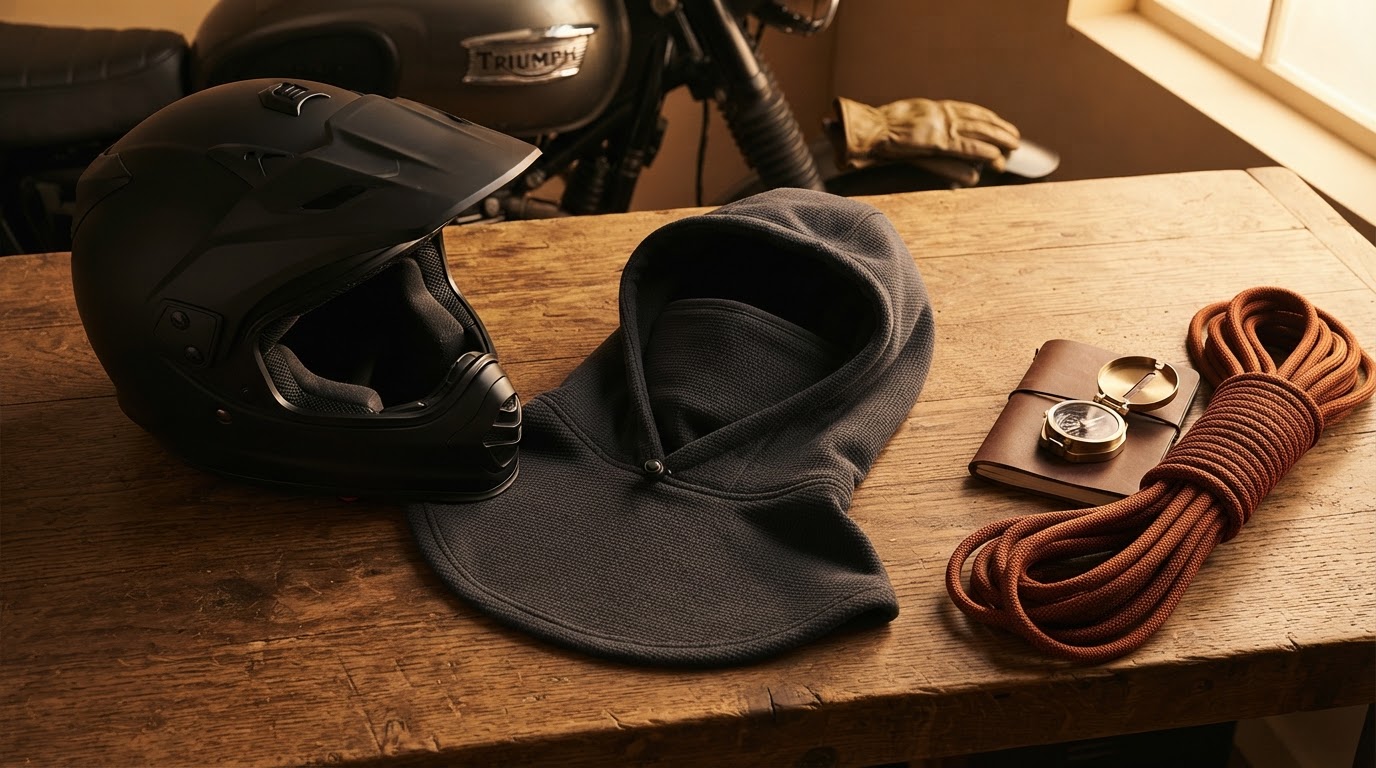
Thermal Balaclava Engineering for Under-Helmet Fit
 Maya ChenContributing Editor
October 8, 2026. This analysis examines the specific mechanical requirements of thin thermal headwear designed to function beneath safety helmets. It serves as a technical resource for consumers seeking to maintain thermal regulation without compromising the structural integrity or fit of their protective equipment.
The Friction Point of Traditional Headwear
The conventional wisdom says that a thicker layer necessarily equals superior warmth, but in the context of high-speed winter sports, this logic fails. When a user forces a standard fleece hood under a precision-fitted motorcycle or ski helmet, they introduce two primary risks: safety compromise through helmet displacement and localized pressure points that restrict cranial blood flow. According to Dainese, their Thermo Balaclava is specifically designed as an insulating under-helmet liner to protect against wind while increasing comfort, acknowledging that the interface between the skin and the helmet shell requires a specialized mid-layer. Most consumers ignore the fact that a helmet's safety rating is predicated on a snug fit against the skull. Adding 5mm of non-compressible fabric effectively renders the helmet one size too small, which can cause the internal EPS liner to sit incorrectly. Furthermore, as discussed in the context of a breathable thermal face mask, the accumulation of exhaled moisture within a cramped helmet space leads to rapid cooling once the activity stops. Here's the part nobody talks about: a thick balaclava often creates a gap at the neck seal, allowing high-velocity wind to enter the jacket, defeating the purpose of the thermal layer entirely. Community feedback from groups like the Facebook Under Helmet Balaclava discussion highlights that brands like Blackstrap and Smartwool have moved toward thinner, high-density knits to solve this specific spatial conflict.
Thermal Balaclava Material Density and Integration
To solve the conflict between insulation and space, the Thermal Balaclava utilizes a high-gauge synthetic blend that prioritizes wind-blocking over sheer bulk. Run the math: a standard polyester fleece has a loft of approximately 300gsm, whereas an optimized under-helmet liner functions at 150-180gsm while maintaining similar thermal resistivity through tighter weave patterns. This reduction in volume allows the breathable thermal ski mask to sit flush against the face, preventing the bunching that typically occurs around the ears and forehead. The design also incorporates flat-lock stitching, a necessity for anyone wearing gear for more than an hour. Traditional raised seams under the pressure of a helmet shell act like dull blades against the skin, leading to contact dermatitis or tension headaches. For individuals who require corrective lenses, the integration becomes even more complex; the best balaclava for glasses wearers must feature specific exit ports or ultra-thin temple channels to prevent the helmet from crushing the frames against the head. The Thermal Balaclava addresses this by using multi-directional stretch fabrics that contour to the hardware of the glasses rather than fighting against them. Unlike generic winter masks, these units focus heavily on the transition zone between the chin and the chest. A moisture wicking winter face shield is only effective if it can move sweat away from the skin before it reaches the saturation point, especially in the high-humidity environment of a closed-face helmet. By utilizing a hydrophobic interior and a hydrophilic exterior, the fabric pulls sweat through the weave, keeping the skin dry even during high-exertion climbs or long snowmobile treks.
Technical Requirements for Under-Helmet Selection
Selecting a liner requires a departure from the "soft and fuzzy" metric used for casual winter wear. A technical under-helmet layer must be evaluated on its ability to maintain a seal while allowing for anatomical movement. As noted by REI Co-op regarding their Under-Helmet Balaclava, the ability to raise and lower the chin piece is a critical functional requirement for temperature regulation in fluctuating environments like Yellowstone. If a mask is too rigid, lowering the chin piece will pull the entire hood forward, obscuring vision—a dangerous trade-off for any rider. Users should also consider the interaction between their mask and their goggles. A moisture wicking winter face shield that lacks a dedicated nasal bridge often directs warm air upward, causing immediate fogging of the lens. I'll change my mind when a single-layer cotton mask can demonstrate the same thermal retention as a dual-density synthetic, but until then, the data supports specialized polymers. Use the following criteria to evaluate a potential under-helmet thermal layer:
- Fabric thickness must not exceed 2mm at the crown to ensure helmet fit remains within manufacturer specifications.
- Seams must be flat-locked or sonic-welded to prevent pressure sores during extended wear.
- The neck gaiter portion should be long enough to tuck beneath the collar of a jacket without pulling tight when the head rotates.
- The facial aperture must maintain its elasticity after repeated stretching to avoid creating gaps that let in cold air.
- Breathability ratings should prioritize vapor transmission to prevent moisture buildup inside the helmet’s EPS liner.